 FocusCurve
· FocusCurve Team · Medication Guides · 5 min read
How Can You Store ADHD Medication at Work?
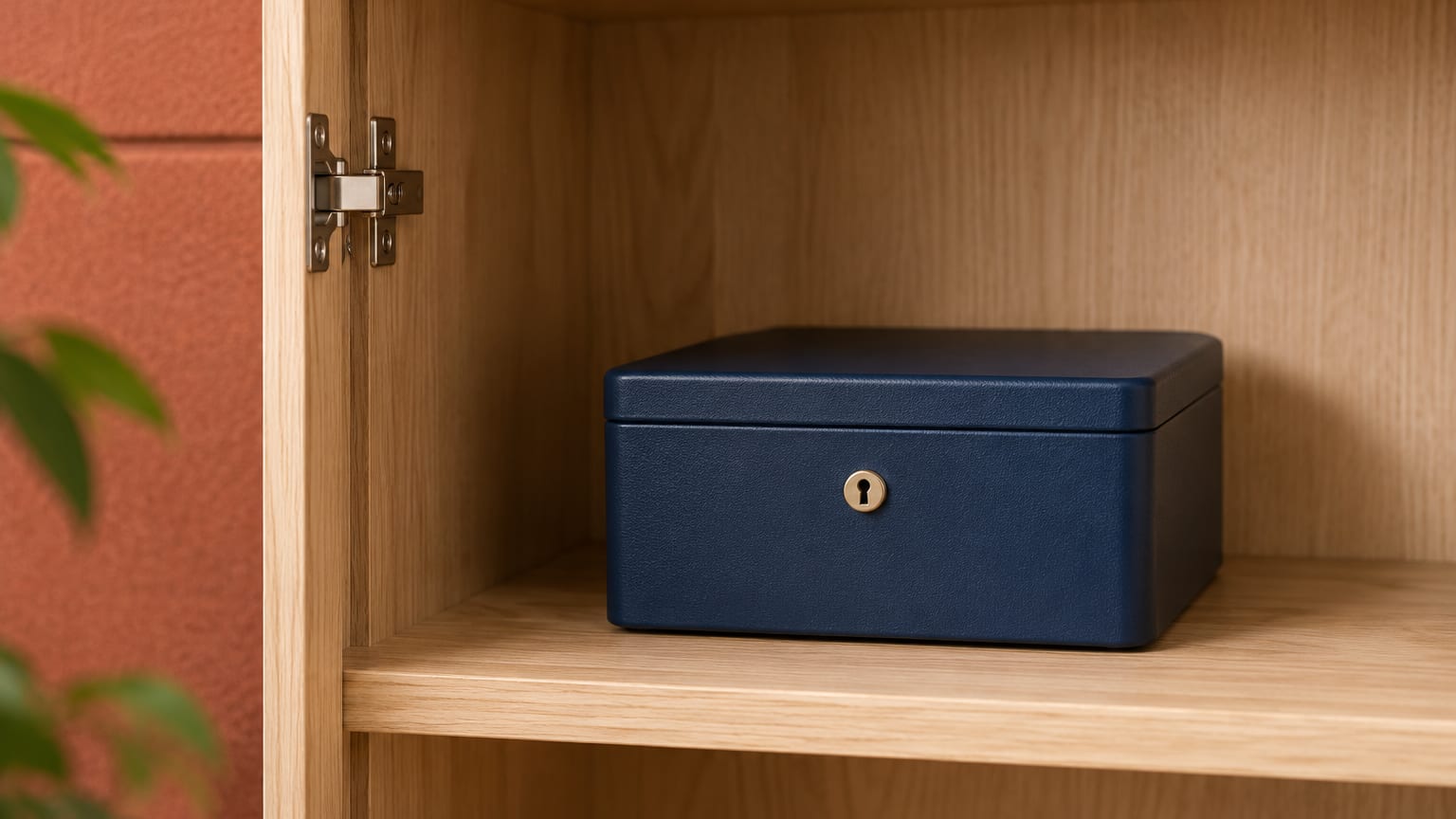
A closed matte navy lockbox with a simple keyhole sits inside a pale oak office cabinet, seen at cabinet height against a softly blurred terracotta wall.
Storing ADHD medication at work raises a practical question: does a desk drawer or office cabinet match the instructions on the medicine’s label? A lock answers only part of that question. The Vyvanse Medication Guide, for example, pairs a locked-cabinet example with a specific room-temperature range (3).
The complete answer involves temperature, packaging, light protection, and secure access. The US labels for Ritalin tablets, Adderall XR capsules, and Vyvanse capsules and chewable tablets specify 20°C to 25°C (68°F to 77°F), with separately permitted excursions. They also describe tight, light-resistant dispensing containers and safe storage. The matching temperatures apply to these named products, not automatically to every ADHD medicine (1; 2; 3).
Which product label applies to medication stored at work?
The label needs to match the exact product and formulation, not just the familiar medicine name. Ritalin’s cited label names methylphenidate hydrochloride tablets; Adderall XR’s names extended-release capsules. The Vyvanse label covers both lisdexamfetamine capsules and chewable tablets. Those formulation details identify which storage instructions you are reading (1; 2; 3).
The source details matter too. The Ritalin label here is from Sandoz; the Adderall XR and Vyvanse labels are from Takeda. An ingredient name alone does not identify those particular labels. For example, “methylphenidate” is less specific than the Ritalin tablet product named in the first source (1; 2; 3).
Storage information appears in two places: section 16 of Ritalin and Adderall XR, section 16.2 of Vyvanse, and each product’s patient Medication Guide. The guides add plain-language details about safe locations and light protection alongside the prescribing information’s temperature and dispensing instructions (1; 2; 3).
What ADHD medication storage temperature do these labels specify?
Ritalin tablets, Adderall XR capsules, and Vyvanse capsules and chewable tablets each specify storage at 20°C to 25°C (68°F to 77°F). Each separately permits excursions between 15°C and 30°C (59°F to 86°F). The wider interval is labeled for excursions, not as a replacement for the stated storage range (1; 2; 3).
For a concrete reading example, 23°C falls within the stated storage range. A reading of 29°C falls within the separately listed excursion interval, but outside the stated storage range. Calling both simply “room temperature” would erase that distinction. Neither reading, by itself, describes the temperature throughout a medicine’s time in an office cabinet (3).
The storage passages refer to USP controlled room temperature without giving a standalone excursion allowance in hours or days. An office question therefore needs the actual conditions: “What temperature is this cabinet when the building is occupied, and when it is closed?” The labels’ numbers do not establish those conditions or supply an unlimited weekend allowance (1; 2; 3).
What container and light protection do the labels require?
All three labels specify dispensing in a tight, light-resistant container. Their Medication Guides also call for protection from light; Ritalin and Vyvanse explicitly say to keep the container tightly closed. These are packaging instructions, separate from whether the office cabinet or drawer has a lock (1; 2; 3).
“Dispense in” describes the container used when supplying the medicine. “Keep the container tightly closed” describes its closure during storage. In the Ritalin label, both appear: the dispensing section specifies a tight, light-resistant container, while the Medication Guide names a tightly closed container and protection from light. One phrase does not replace the other (1).
Consider a bottle inside a locked office cabinet. There are still separate questions about the bottle’s closure and light protection. A cabinet key does not describe either feature of the medicine’s container. Likewise, “pill organizer” names an object, not proof that it meets the tight, light-resistant container specifications in these labels (1; 2; 3).
Do ADHD medication labels call for locked storage?
The Ritalin label says to store it in a safe place, “preferably locked.” The Adderall XR and Vyvanse Medication Guides give a locked cabinet as an example of a safe place. Their wording addresses secure access; it does not replace the same products’ temperature, light-protection, or container instructions (1; 2; 3).
For storing medication at the office, the Vyvanse guide puts the pieces together particularly plainly: a safe place, such as a locked cabinet, at 20°C to 25°C (68°F to 77°F), with the container tightly closed and the medicine protected from light. “Locked” is one part of that description, not a complete storage specification (3).
For separate questions, see airport medication screening and a prescriber conversation about medication timing. FocusCurve’s App Store listing describes its dose-time log and approximate timeline; the app keeps health records on-device.
Frequently asked questions
Does the Vyvanse storage range cover chewable tablets too?
Yes. This Vyvanse label covers both capsules and chewable tablets, and its storage section gives room temperature as 20°C to 25°C (68°F to 77°F). It separately permits excursions between 15°C and 30°C (59°F to 86°F); those are not the stated routine storage range (Vyvanse label, section 16.2).
Do these labels approve a particular pill organizer?
The cited storage sections specify dispensing in a tight, light-resistant container; they do not approve a particular pill organizer. Ritalin and Vyvanse also explicitly tell patients to keep the container tightly closed, so an organizer’s compartment layout alone does not establish that it meets the packaging instructions (Ritalin and Vyvanse labels).
How long can medication stay at an excursion temperature?
These storage passages give permitted excursion temperatures but no standalone allowance in hours or days. They do not establish that a bottle can remain at an excursion temperature for an entire workweek or weekend; the numerical range alone cannot answer that duration question (Ritalin, Adderall XR, and Vyvanse labels).
References
- RITALIN tablets — DailyMed label, revised February 2025, sections 5.1, 16, and Medication Guide dailymed.nlm.nih.gov
- ADDERALL XR extended-release capsules — DailyMed label, revised April 2026, section 16 and Medication Guide dailymed.nlm.nih.gov
- VYVANSE capsules and chewable tablets — DailyMed label, revised April 2026, section 16.2 and Medication Guide dailymed.nlm.nih.gov
Medical disclaimer
This article is for educational and informational purposes only. It is not medical advice, diagnosis, or treatment. The information presented is based on published research from FDA-approved prescribing information, peer-reviewed pharmacokinetic studies, and NCBI Bookshelf references, but it is simplified for a general audience and does not capture the full complexity of individual pharmacokinetics.
All half-lives, timelines, and percentages discussed are approximate population averages. Your individual experience may differ significantly based on your genetics, metabolism, body composition, other medications, and many other factors.
Do not start, stop, or change your medication based on this article. Always talk to your prescriber or doctor before making any changes to your treatment plan.
FocusCurve is a visualization and educational tool -- not a medical device. It does not provide medical advice, diagnosis, or treatment recommendations. All estimates shown in the app are approximate, based on generalized models and published population-average parameters.
- ADHD Medication
- Medication Storage
- Work